
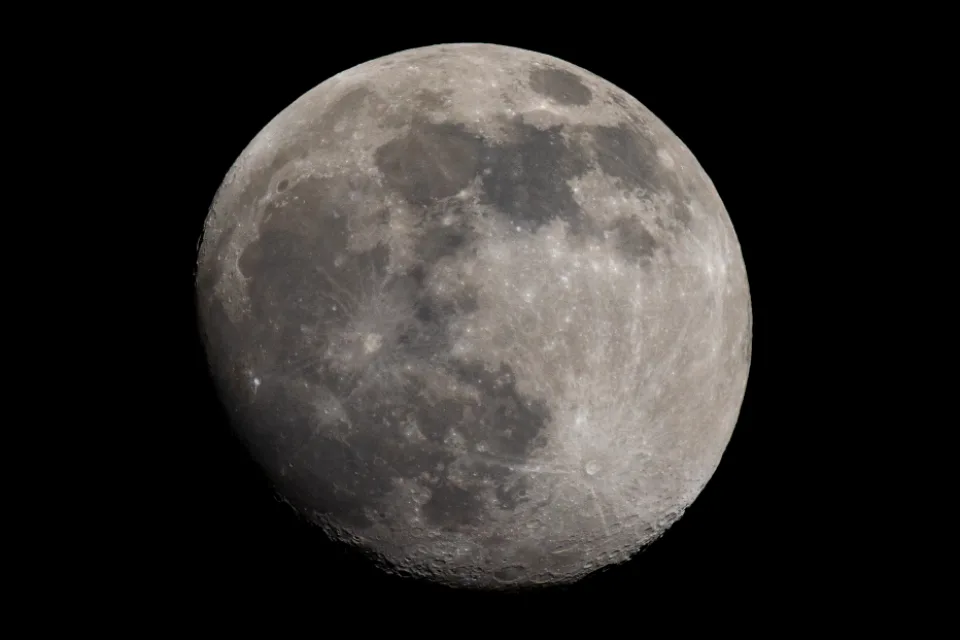

Look up at the Moon and you see the same face every time: a bright surface splashed with dark patches, the old lava plains called maria. The side we never see from Earth looks very different. It is rugged, heavily cratered and almost free of those dark plains. Scientists have argued about why for decades.
A team led by Hejiu Hui of Nanjing University now offers a new answer, based on the first rocks ever brought back from the far side. Their idea: Earth’s gravity heated one side of the young Moon more than the other, and that uneven heat pushed molten rock around like a slow conveyor belt.
How Lopsided Is the Moon?
Very. Roughly 31% of the near side is covered by maria, compared with about 1% of the far side, according to a summary by the Houston Museum of Natural Science. NASA’s GRAIL gravity mission also found in 2012 that the far side carries an extra layer of crust, about 3 to 6 miles (5 to 10 km) thick, that the near side lacks.
What the New Samples Showed
China’s Chang’e-6 lander returned the first far-side samples in 2024. The researchers analyzed 37 fragments of highland rock and 10 fragments of basalt from one of those samples and compared them with rocks collected by Apollo astronauts and by China’s Chang’e-5 on the near side.
- The deep interior looks similar. The far-side basalts, about 2.8 billion years old, came from a mantle source much like that of Apollo’s low-titanium basalts. In other words, there is no clear split between the two hemispheres deep down.
- The crust is different. Far-side anorthosite, the pale rock of the lunar highlands, is richer in magnesium than its near-side counterparts (a median magnesium number of 66.4 versus 63.0).
- Fewer late-stage leftovers. Far-side samples were very low in KREEP, a mix of potassium, rare earth elements and phosphorus that formed in the last dregs of the Moon’s early magma ocean and is concentrated on the near side.
The Proposed Explanation
The early Moon was covered by a deep ocean of magma. Once the Moon became tidally locked, always showing Earth the same face, the team argues that Earth’s pull heated the near side more. That temperature difference drove sideways flows inside the magma ocean, carrying magnesium-rich crust-forming material toward the far side and thickening it, while heat-producing KREEP-rich leftovers pooled on the near side. Those leftovers may help explain why the near side later flooded with lava.
The findings appear in the journal National Science Review. The paper went online in July, and a press release about it was published this week.
The Catch
The authors call this a possible explanation, not a settled one. All the far-side material comes from a single landing site, so it may not represent the whole hemisphere. For some of the chemical differences, the team offers two competing explanations without choosing between them. Other ideas, including a giant impact on the near side, are still in play. More samples from more places would be the real test, and future far-side missions could supply them.
For skywatchers, it is a nice thing to keep in mind on the next clear night: those dark patches may be a scar left by Earth itself. Our October night sky guide has the best dates to look.
More on Contoh
- NASA Picks a Mission to Find Out Whether a Hole on the Moon Leads to a Giant Cave
- October’s Night Sky: Orionid Meteors, a Bright Saturn and the Full Moon
- NASA’s Perseverance Rover Breaks the Off-World Driving Record, Passing 28 Miles on Mars
Sources
- ScienceDaily: Scientists may have finally solved the mystery of the Moon’s two faces
- National Science Review: Lunar farside-nearside asymmetry formation during magma ocean solidification (Gu et al., 2026)
- Houston Museum of Natural Science: Why the far side of the Moon is so different from the near side