
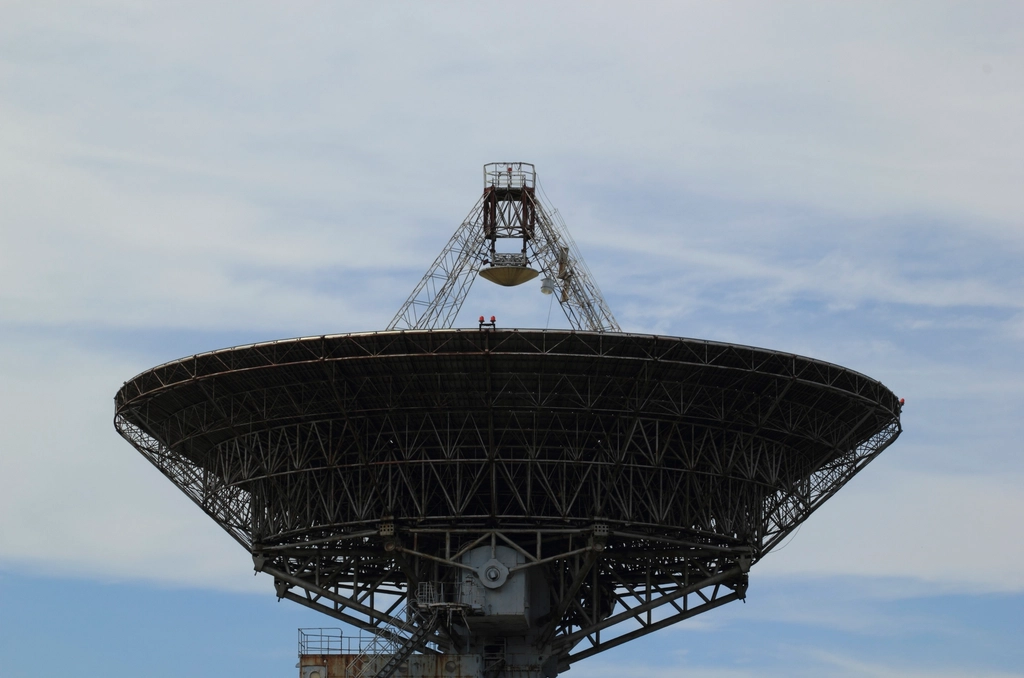

A Canadian radio telescope has picked up one of the faintest signals in astronomy: the glow of hydrogen gas spread across the distant universe, emitted when the cosmos was only about 5 billion years old.
The team behind the Canadian Hydrogen Intensity Mapping Experiment, or CHIME, says it detected the signal using only its own data, a first for the telescope. The light has been traveling for about 9 billion years to reach Earth. The results appear in two companion papers in The Astrophysical Journal.
What They Found
Hydrogen is the most common element in the universe, and in its neutral form it gives off faint radio waves at a known wavelength. Instead of picking out individual galaxies, CHIME measures the combined radio glow from huge volumes of space. Mapping that glow shows how matter is spread out across the cosmos.
“Its faint radio emission acts like a cosmic tracer, revealing how matter is distributed across space,” said Arnab Chakraborty, a postdoctoral fellow at the University of Toronto who first proposed the finding.
Key details from the study:
- The analysis used 94 nights of observations from 2019.
- The team estimates that roughly 2% of the universe’s hydrogen was in neutral atomic form at that time, which it says is broadly consistent with other measurements.
- Researchers spent more than a year testing the signal to rule out a false alarm.
Neutral hydrogen gives off radio waves with a wavelength of about 21 centimeters (roughly 8 inches). As the universe expands, that light gets stretched on its way to us, so the wavelength that arrives at the telescope tells astronomers how far back in time they are looking. That is what lets CHIME build up a three-dimensional picture of where gas sat billions of years ago.
Why It Was So Hard
The hydrogen signal is buried under far stronger radio noise, including emission from our own galaxy, human-made signals and quirks of the telescope itself. The team developed new data processing methods to peel those layers away.
“We worked very hard to convince ourselves that this wasn’t a false alarm,” Chakraborty said.
“Our data indicate that roughly two per cent of the hydrogen in the universe was in neutral atomic form at this time, broadly consistent with other measurements,” said Shabbir Shaikh, a postdoctoral fellow at Arizona State University. Agreement with earlier, independent estimates is one sign that the processing did not invent a signal out of noise.
Who Was Involved
The work involved researchers from UBC, McGill University, the University of Toronto, the NRC’s Dominion Radio Astrophysical Observatory and Arizona State University. CHIME is perhaps better known to the public for detecting large numbers of fast radio bursts, mysterious millisecond flashes from distant galaxies, but hydrogen mapping was one of its original goals.
Why It Matters
The long-term goal is to use hydrogen maps to measure how fast the universe has been expanding over time. That could help test competing explanations for dark energy, the mysterious something that appears to be speeding up that expansion.
According to the University of British Columbia, this approach can survey larger areas of sky and look further back in time than traditional galaxy surveys, and it is much cheaper. CHIME, located near Penticton, British Columbia, is a stationary telescope with no moving parts and is hosted by the National Research Council of Canada. U.S. researchers at Arizona State University are part of the collaboration.
“For a long time, astrophysicists have believed there is great potential in this hydrogen mapping technique with this kind of telescope,” said Simon Foreman, an assistant professor at Arizona State.
The Catch
- This is a detection of the signal, not yet a new measurement of dark energy. The papers do not report any constraint on dark energy itself.
- Because the signal had to be pulled out from much stronger interference, the result depends heavily on the processing methods.
- Only a small slice of CHIME’s data was used. The telescope has been operating for nearly seven years.
What’s Next
The team plans to analyze the rest of its archive and push the technique back to an earlier era, when the universe was about 3 billion years old. Those measurements could then be used to test dark energy models and theories of how galaxies formed.
Mark Halpern, CHIME’s principal investigator at UBC, called it “a bold new step in the global cosmology program.”
More on Contoh
- Hubble May Have Spotted a Planet Born After Its Star Died
- NASA’s Roman Space Telescope Passes a Key Steadiness Test and Takes Its First Coronagraph Look