
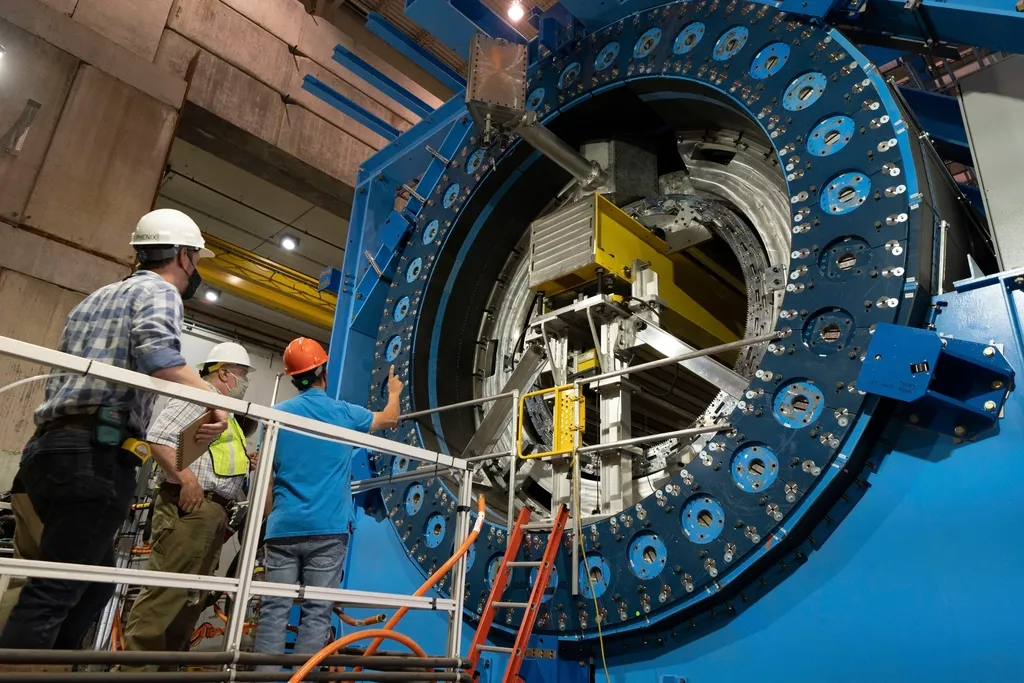

Physicists at CERN say they have found evidence of a particle decay so rare that it should happen only about once in every 10 billion decays of a particular particle. The result comes from the LHCb experiment at the Large Hadron Collider near Geneva, and it ends a search that has run for more than 40 years.
The decay involves a Bd meson, a short-lived particle containing a beauty quark, turning into a muon and an antimuon. Physicists call it a “golden channel” because the Standard Model, the field’s best theory of known particles, predicts it so precisely. If measurements ever drifted from that prediction, it could point to new, undiscovered particles.
What was found
The LHCb team reports a signal at 3.0 standard deviations using data collected in 2024 and 2025. Combined with data from 2011 to 2018, the figure rises to 3.2. In particle physics, 3 sigma counts as “evidence,” while 5 sigma is needed to claim an “observation.” So this is a strong hint, not a confirmed discovery.
The same analysis produced the most precise measurement yet of a close cousin, the Bs decay into the same pair of particles. That one happens about 3 times per billion decays, roughly 30 times more often than the Bd version.
Why it matters
Rare decays act like a sensitive scale. Heavy particles too massive to be created directly at the collider can still nudge how often a decay happens. So far, the results agree with the Standard Model, which means no sign of new physics yet. But the measurement now constrains theories that predict a different rate.
Two things made the new result possible. LHCb’s upgraded detector began collecting data in 2024 at five times its earlier rate, and the team used machine learning to separate the faint signal from background noise. A team of 19 scientists carried out the analysis.
The catch
An earlier analysis in 2015 also reported initial evidence for this decay, but later work through 2018 could not confirm it. That history is a good reason for caution. Physicists expect more data from the High-Luminosity LHC, scheduled to start in 2030, and from another LHCb upgrade planned for the mid-2030s, which together could multiply the data rate by about 10 again.
For now, the practical takeaway is simple: the Standard Model passed another test, and the hunt for what lies beyond it continues. The press report does not cite a journal paper yet, so details may be refined when the full results are published.
More on Contoh
- Gas Leaks on Mars Hint at Hidden Volcanic Heat Beneath Alba Mons, Study Finds
- Dinosaur Blood Chemistry Found in 115-Million-Year-Old Fossil, Researchers Report