
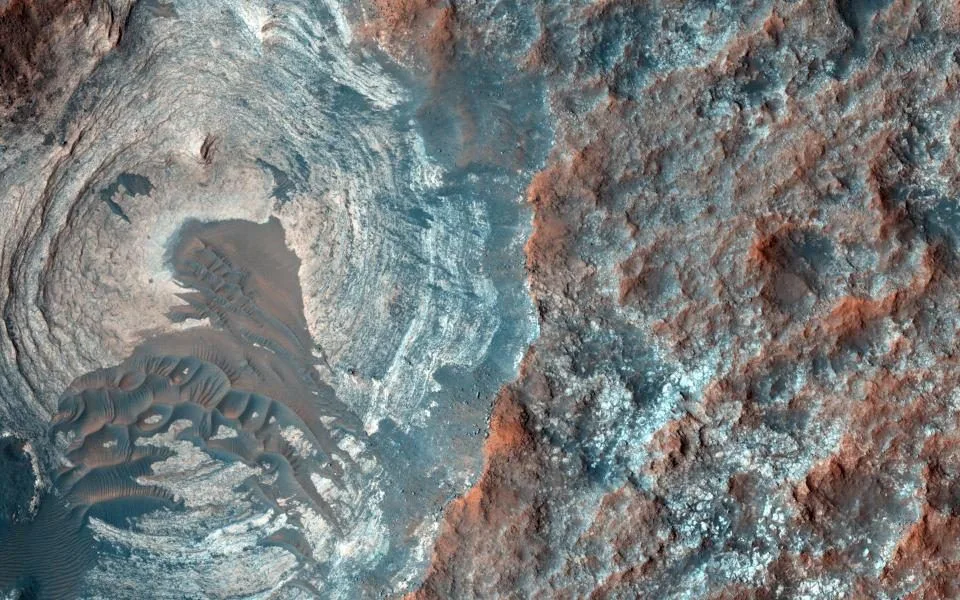

Gas seeping from cracks on the slopes of a giant Martian volcano may be a sign that Mars still has heat and molten rock deep underground. A new study points to hydrogen chloride, a gas that on Earth often escapes from vents connected to magma.
The finding comes from the European Space Agency’s ExoMars Trace Gas Orbiter and was published in Science Advances. It does not show that Mars is erupting, and it does not show life. But it gives scientists a specific place to look.
What the Orbiter Saw
Hydrogen chloride in the Martian atmosphere normally follows a seasonal pattern. It peaks in northern winter and drops to very low levels in summer, a cycle tied to the planet’s dust and water.
The team, led by Alexander Trokhimovskiy, found an exception. In early northern summer, the gas repeatedly showed up in elevated amounts over one small area: volcanic fractures on the slopes of Alba Mons, one of Mars’s largest volcanic regions.
The orbiter’s camera then showed narrow, apparently fresh cracks there, some stretching hundreds of meters (several hundred feet). The surface around them showed unusual color changes, which the researchers say could be minerals left behind by escaping gas, much like the deposits around volcanic vents on Earth.
Why Volcanic Heat Is the Leading Explanation
The researchers spent a large share of the work trying to rule out ordinary atmospheric chemistry. After weighing both the gas data and the surface imagery, they proposed that the hydrogen chloride could be leaking from a dormant magma chamber beneath Alba Mons.
“Our findings suggest that Mars has retained enough internal heat to support volcanic activity until recently, and possibly still does,” said co-lead author Daniel Mège of the Polish Academy of Sciences’ Space Research Centre.
The Catch
Scientists have never directly watched a new eruption or fresh lava flow on Mars. Orbital images show some volcanoes erupted within the past few million years, and seismometers have recorded marsquakes, but present-day volcanism is still unproven. The Alba Mons result is strong circumstantial evidence, not a confirmed eruption.
Why It Matters
Warm, wet pockets underground are among the best places microbes could survive on a cold, dry planet. If rising magma meets groundwater, it can create hydrothermal systems, which offer both energy and shelter from the harsh surface. “Looking for Martian life in the seeping fissures of the Alba Mons region would make a lot of sense,” Mège said.
That is a long way from finding anything alive. For now, it is a new target for future missions, and a reminder that Mars may be less dead than it looks. For more Red Planet news, see NASA’s Perseverance rover driving record below.
More on Contoh
- NASA’s Perseverance Rover Breaks the Off-World Driving Record, Passing 28 Miles on Mars
- NASA Asks Private Companies How to Keep Hubble in Orbit Past 2033