
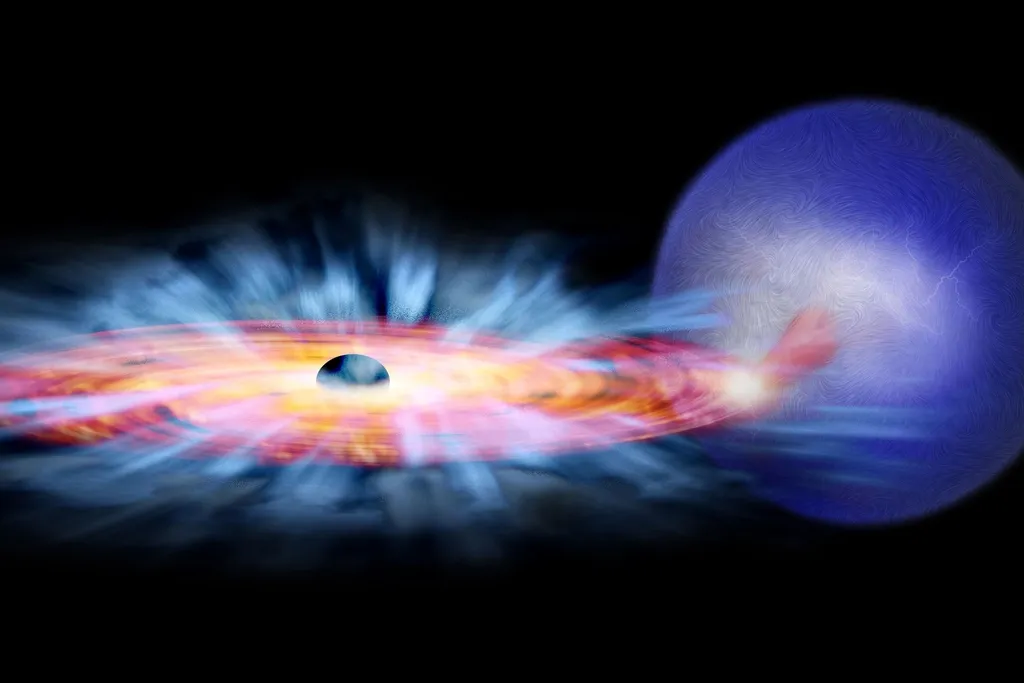

Most of the black holes that LIGO and its partner detectors have caught colliding weigh about the same: roughly 10 times the mass of our Sun. Now a Caltech-led team says that pile-up, and a conspicuous shortage of slightly heavier black holes, may point to a way some stars die without ever exploding.
The work, published in Physical Review D, is a proposal backed by data, not a confirmed discovery. But it ties a puzzle in gravitational-wave astronomy to an old question about what happens when a massive star runs out of fuel.
What the researchers found
The team analyzed 257 black hole mergers recorded by the LIGO, Virgo and KAGRA detector network over the past decade. About three-quarters of the black holes in that sample sit near 10 solar masses. Meanwhile, there are noticeably fewer black holes between 12 and 16 solar masses, a gap the team set out to explain.
“We see 10 solar-mass black holes merging all the time,” said lead author Isaac Legred, now a postdoctoral researcher at the University of Illinois Urbana-Champaign. Co-author Katerina Chatziioannou, a Caltech physics professor and LIGO team member, put it more broadly: the vast majority of merging black holes in the universe are about 10 times the Sun’s mass.
The “failed supernova” idea
When a very massive star exhausts its fuel, its core collapses. In many cases that triggers a supernova, a blast that blows much of the star apart and can leave behind a neutron star or a black hole. In a “failed supernova,” the explosion never takes hold and the star collapses more or less directly into a black hole.
The paper, titled “Low-mass failed supernovae and the 10M⊙ peak in the merging black hole mass distribution,” argues that the gravitational-wave data fit a scenario in which most black holes in merging pairs were born this way. If low-mass stars that fail to explode produce black holes clustered near 10 solar masses, you would expect both the big peak and the drop-off just above it.
Why it matters
Gravitational waves, ripples in space-time that LIGO first detected directly in 2015, have now revealed more than 300 black hole collisions. Each one carries a clue about how the black holes formed. By looking at the whole population instead of single events, astronomers can test theories of stellar death that are very hard to check with telescopes alone, since a star that quietly turns into a black hole can be easy to miss.
The research was supported by the National Science Foundation, the U.S. Department of Energy and the Simons Foundation. The other authors are Jacob Golomb and Katerina Chatziioannou.
The catch
The authors are careful here. The results are “consistent with” the failed-supernova explanation, but they do not directly confirm that such events exist, and astronomers have yet to confirm a specific case of a failed supernova. Legred said more research is needed. Other explanations remain possible, so expect the idea to be tested as the detector network keeps listening and the catalog of mergers grows.
More on Contoh
- Europe’s Hera Probe Is Flying Rectangles Around the Asteroid NASA Hit in 2022
- CERN Finds Evidence of a One-in-10-Billion Particle Decay After a 40-Year Search
- Euclid Space Telescope Discovers Its First Comet, About 1.3 Billion Kilometers Away