
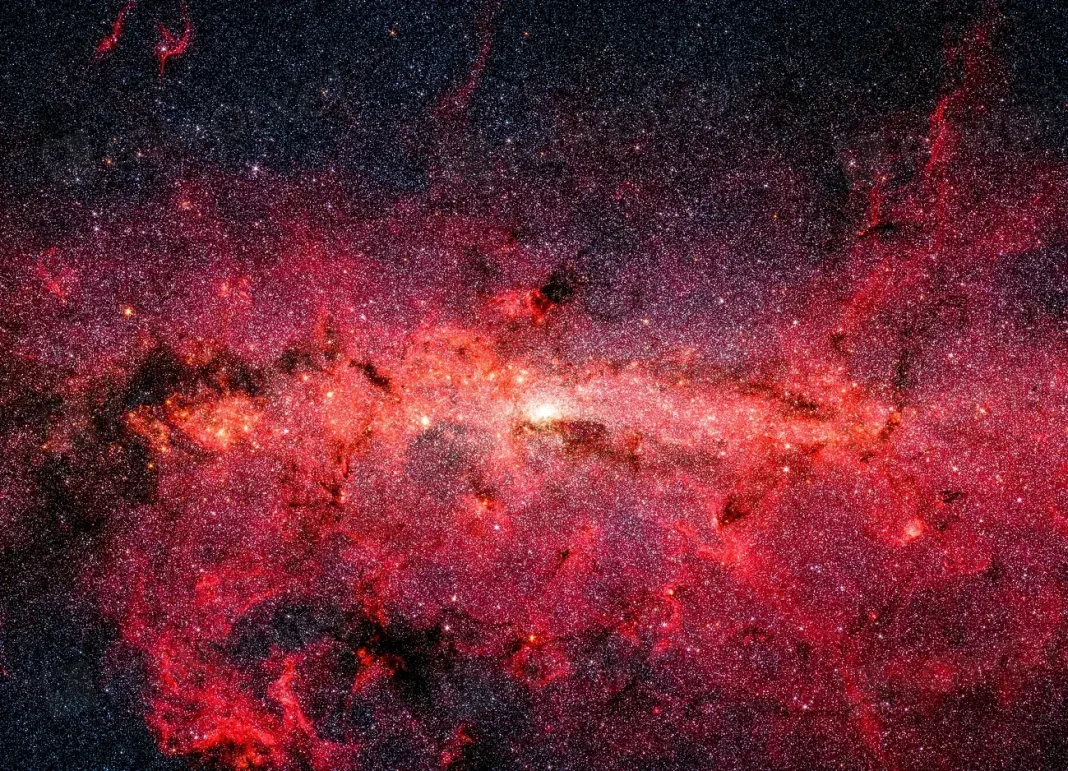

At the heart of the Milky Way sits Sagittarius A*, a supermassive black hole about 4.3 million times the mass of the sun. Astronomers have now spotted a star that orbits it more tightly and more quickly than any other known star — and it may help answer one of the biggest open questions about the black hole: how fast it spins.
The star, named S301, completes a lap every 8.7 years. At its closest approach it comes within about 12 astronomical units of the black hole, roughly the distance between the sun and Saturn, and reaches speeds of around 25,000 kilometers per second (about 15,500 miles per second). That is about 8% of the speed of light.
The discovery, led by the Max Planck Institute for Extraterrestrial Physics (MPE) in Germany, was published in Nature on August 19.
Why this star matters
Einstein’s general relativity predicts that a spinning black hole drags the fabric of space-time around with it, an effect known as frame-dragging, or the Lense-Thirring effect. Astronomers have already used another star, S2, to measure how the black hole’s mass bends space-time. But detecting the spin requires a star that gets even closer.
According to MPE, S301 is the first star expected to show measurable effects of frame-dragging from a rotating black hole. “Within the next decade, we will measure the black hole’s rotation directly — a milestone for general relativity,” said MPE director Reinhard Genzel, a 2020 Nobel laureate in physics.
A very faint needle in a bright haystack
Finding S301 was hard. The institute says it is roughly two billion times fainter than the bright star Betelgeuse and sits among neighbors that are about 100,000 times brighter. The team spotted it with GRAVITY+, an upgraded instrument on the European Southern Observatory’s Very Large Telescope Interferometer in Chile, which combines light from four 26-foot (8-meter) telescopes. The researchers also had to develop new data-analysis methods to pull the star’s faint signal out of the noise.
Sci.News reports the star was first detected in spring 2023, with confirmed sightings in archival data going back to 2017.
The catch
Spotting the star is only step one. The frame-dragging signal is subtle, so astronomers will need many more observations over years. MPE says pinning down the direction of the black hole’s spin could take around 15 years, combining GRAVITY+ position data with speed measurements from MICADO, an instrument planned for ESO’s Extremely Large Telescope. The fact that new analysis methods were needed to find S301 also suggests other faint stars may have been missed — which could be good news for future discoveries.
More on Contoh
- NASA’s Roman Space Telescope Passes a Key Steadiness Test and Takes Its First Coronagraph Look
- Europe’s Jupiter Probe Juice Swings Past Earth and Picks Up a Big Speed Boost
- NASA Picks a Mission to Find Out Whether a Hole on the Moon Leads to a Giant Cave