
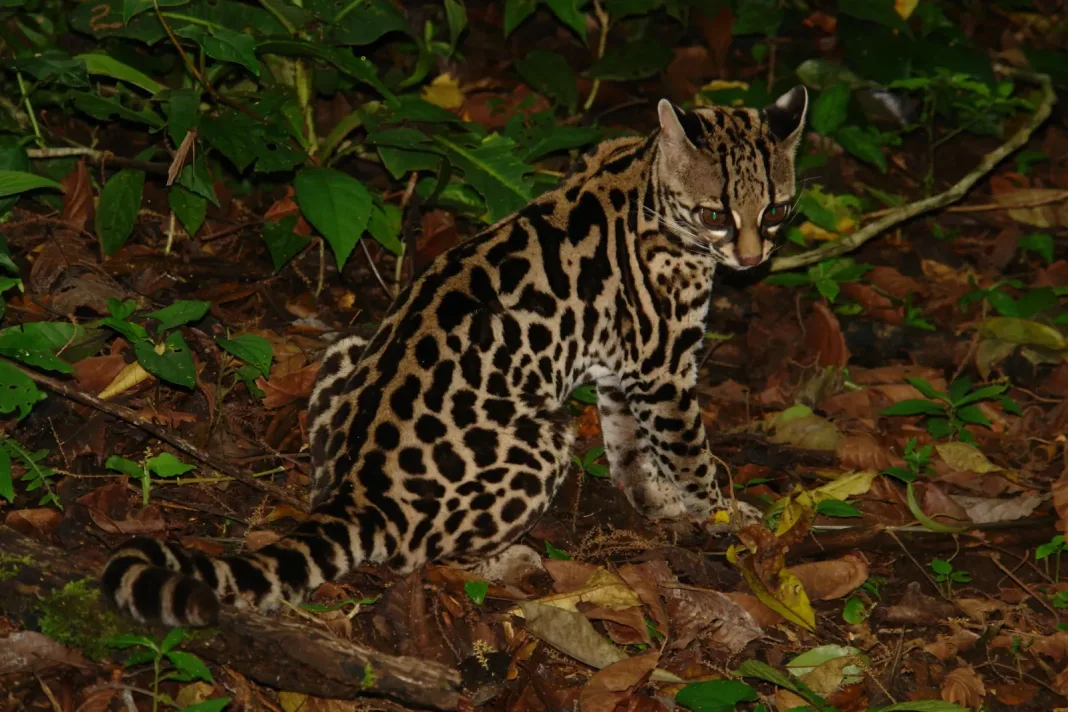

Scientists have identified a new species of wild cat in Bolivia — the first living cat species to be formally named and described in more than 100 years.
The animal, Leopardus tilcayo, takes its name from “tilcayo,” a local name for the cat. It lives in the Yungas, a mountainous region of humid, cloud-covered forest. The study was published in Current Biology on September 17.
Smaller than a house cat
The tilcayo is tiny. Al Jazeera reports it measures about 18 inches (46 cm) long and weighs around 3 pounds (1.4 kg) — smaller than an average domestic cat. The formal description gives a head-and-body length of about 17 to 20 inches (42.5 to 50.5 cm), with a tail of roughly 10 inches (25 to 26.5 cm). Its light brown coat is marked with large, irregular dark rosettes.
“The first time I saw it, it was really, really small and skinny,” Paola Nogales-Ascarrunz, a co-author and National Geographic Explorer, told ABC News.
Found in the DNA
The tilcayo belongs to a group known as tiger cats, small spotted cats long lumped together as one or two species. The research team, with Jonas Lescroart of the University of Antwerp as lead researcher, analyzed complete genomes from 38 cats across South America, including eight museum specimens.
The results showed tiger cats actually make up five genetically distinct species. The tilcayo’s lineage split from other tiger cats about 1.4 million years ago. The team also described a new subspecies from Peru’s Yungas, Leopardus tigrinus antisuyo.
Little is known about how the tilcayo lives. Scat samples suggest it eats small rodents, and camera traps indicate it is active at night.
The catch
Naming a species is the start, not the end, of understanding it. According to ABC News, only one tilcayo is confirmed in captivity, and its full range and behavior remain largely unknown. The genetic study also found that nearly all tiger cat lineages show long-term population declines, some of more than 60%.
Splitting tiger cats into more species has conservation consequences, too: smaller species groups mean smaller populations, and ABC reports several are now considered vulnerable. The Yungas faces deforestation and wildfires. Nogales-Ascarrunz hopes the discovery will draw attention to small, overlooked cats, not just big ones.
More on Contoh
- A Large Australian Stick Insect Hid in Plain Sight for Decades
- Galápagos Corals Suggest El Niño Is Stronger Now Than at Any Time in 1,000 Years
- A Forgotten 30-Year Forest Experiment Found Thinned Stands Stored as Much Carbon as Untouched Ones